
A striker breaks. A defender holds the line. Two centimetres separate a goal from an offside flag.
At the 2026 World Cup, that call comes back in seconds. Drawn to the centimetre. Live, on the stadium screens.
Watch it land and you reach for the obvious answer: a machine made the call.
It didn't. Not really.
The line you see is the end of a long chain. And the chain doesn't start with a sensor. It starts with people.
Before any camera could find a player, a person had to teach it what a player looks like. Before any system could map a pitch, a person had to mark where the lines are. Frame by frame. Point by point. By hand.
The most advanced sports AI on Earth runs at this World Cup. Under it sits a foundation almost nobody talks about — millions of human-labeled examples.1
Here is the hidden story: who taught the World Cup's AI to see?
How the machine learns the pitch and players
In the Annota8 Annotation Engine, a person marks the fixed landmarks first. Touchlines. Goal. Penalty box. Centre circle. The halfway line.
Those marks tie a flat broadcast frame to the real, measured pitch. State-of-the-art soccer calibration defines 57 geometric keypoints across 26 labeled marking classes — humans place them by hand.23
The machine does not see a field. People define the geometry first.
Then come the players. A box around each player teaches detection — this is a body, here, in this frame. Then keypoints for posture: head, shoulders, hips, feet. Those are the limbs that decide an offside.
The limbs that decide an offside
Up to 29 skeletal points per player, read many times a second.4 A model only finds an ankle because a person labeled ankles first — frame after frame, angle after angle.
One angle is not enough. So the same player gets boxed from every view — broadcast high, behind the goal, tactical wide. Box the same body in each frame and a flat image becomes a 3D position. At a 2026 stadium, 16 optical cameras watch at once.4
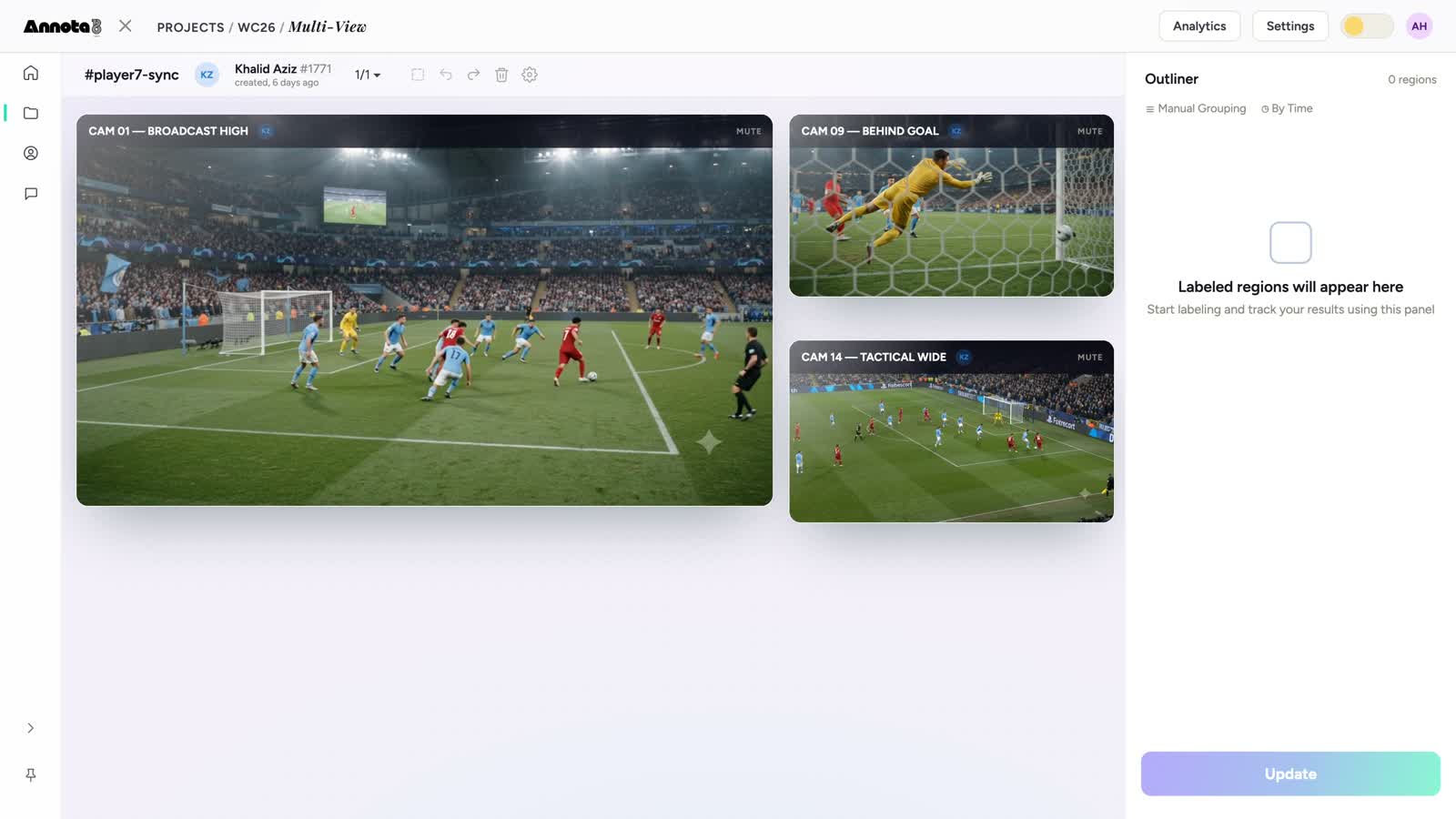
This is illustration, not FIFA's pipeline. But the lesson holds everywhere. The open SoccerNet dataset alone carries 9.37 million hand-placed pitch-line points and 2.36 million labeled player positions.1
The ball that broke the cameras
Cameras are built for bodies, not bullets. A struck ball can move faster than the eye and faster than the frame. It blurs. It shrinks to a few pixels. A leg swings across and hides it.
That is the optics problem. Production computer vision learns from human-labeled frames, and its accuracy degrades when the data is thin or the object is hard to see.5 A ball mid-flight is the hardest frame there is.
So FIFA stopped asking the cameras to do it alone.
The 2026 World Cup is played with the adidas Trionda. Inside one of its four panels sits a 500Hz motion sensor — moved out of the centre, where Qatar 2022 suspended it, and built into the panel itself.6 It reads the ball 500 times a second.
Built with Kinexon, that sensor pinpoints the exact moment of a touch to within about two milliseconds7 — a precision no camera frame rate can reach.
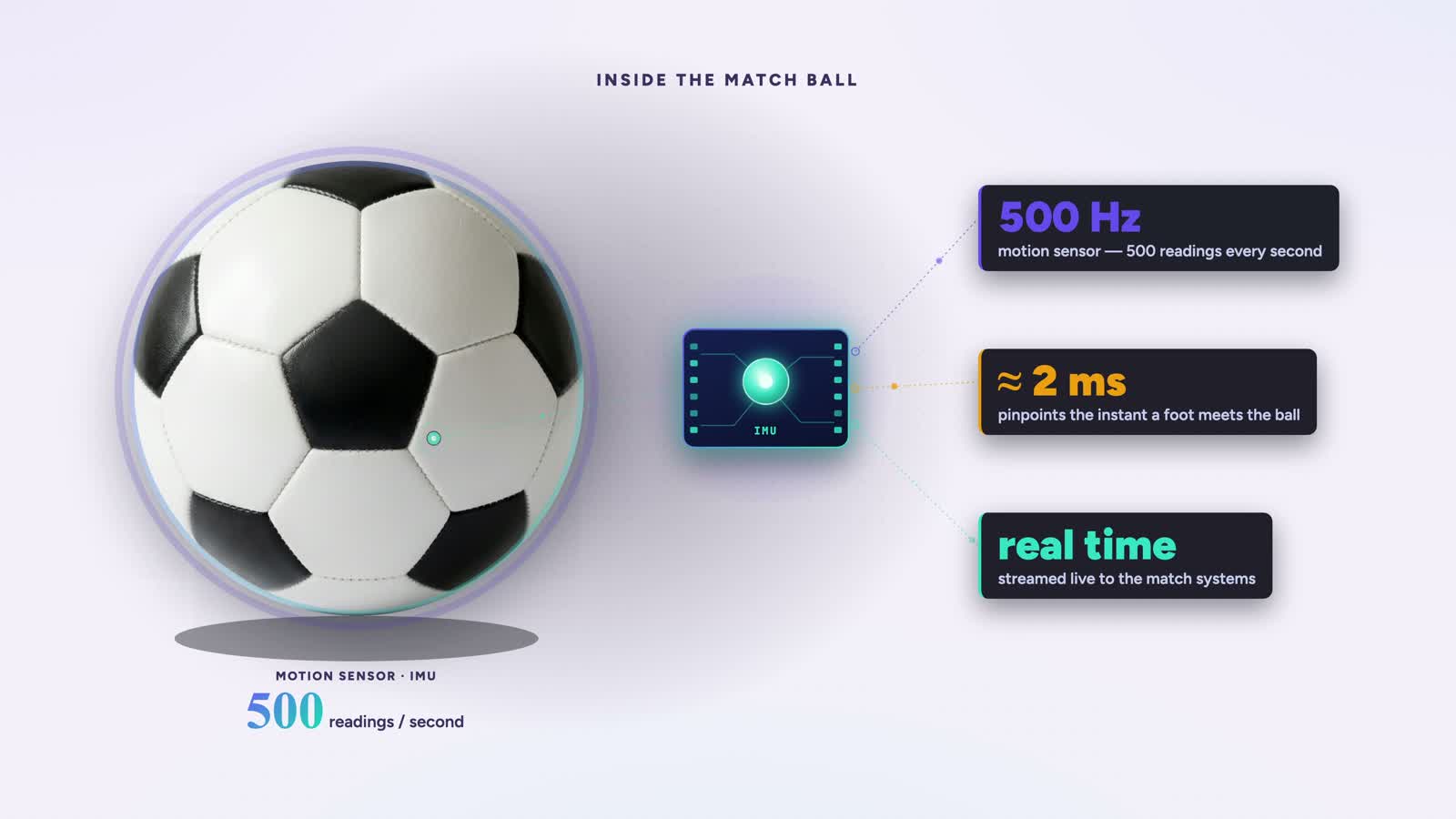
Eyes outside. A heartbeat within. The cameras watch the pitch. The chip feels the kick. Together they catch what neither could alone — the millisecond the ball was struck.
Is offside fully automatic at the 2026 World Cup? No — the machine measures, people decide
Here is the honest part. Almost nothing at this World Cup is fully automatic.
One thing is: goal-line technology. About seven cameras watch each goal. Millimetre accuracy. The referee's watch buzzes in about a second. It has been the World Cup standard since 2014 — not new, not the ball chip, not offside.89
It answers one question. Did the whole ball cross the line? Yes or no. Nothing else.
Offside gets a second automated output, and it's new for 2026. An advanced version of Semi-Automated Offside Technology sends clear offsides straight to the assistant referees on the pitch — not just the VAR booth — so the flag goes up faster.4
But read the word again. Semi-automated. The system measures position. The on-pitch official still makes the call.
Automated The machine answers
- Goal-line: did the whole ball cross? (fully automatic, since 2014)
- Clear positional offside: alert to the official (semi-automatic, new for 2026)
Human People decide
- Fouls, penalties, handball
- Interfering with play, a ball just over the line
- Every judgment call — informed by the data
Everything else stays human. A foul. A penalty. A handball. A ball that sits just over the line. The machine measures. People decide.4
And that is the feature, not the bug. The line is drawn to the centimetre because humans defined what correct looks like — frame by frame, example after example. The narrow band the machine can call, it can call because people taught it. The wide band it can't, it leaves to people.
The human layer underneath
Here is the part nobody puts on the broadcast. Before any model can watch a match, a person has to teach it to see. Not the AI. A human, frame by frame.
Look at the open research and the scale of that teaching shows up fast. The SoccerNet game-state dataset — academic, not FIFA's, not ours — carries 9.37 million pitch-line points placed by hand to teach a model where the field is.1 The same dataset hand-labels 2.36 million player positions, each tagged with role, team, and number.1
That is one open dataset. Underneath one sport. A model does not learn a touchline because it is clever — it learns because someone drew that line a million times, across angles, lighting and jerseys, until the pattern stuck.
It doesn't hallucinate because someone wrote a bad function. It hallucinates because nobody gave it enough good examples.
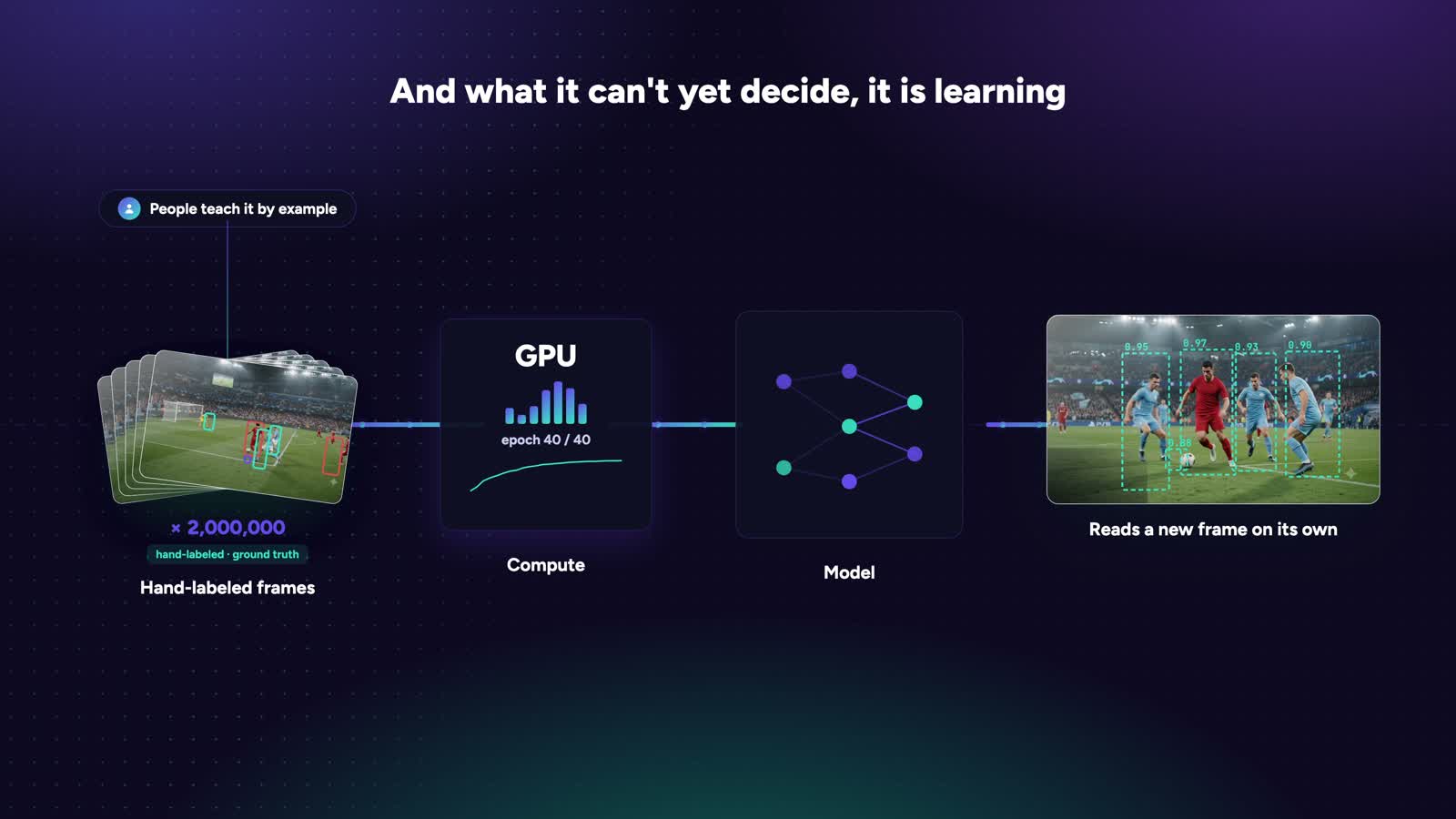
Humans teach the machine.Your AI is only as good as the people who taught it
The biggest stage in sport learns the way every intelligence learns. From human hands.
I'm Ahmed Rafiq Fahmy. My co-founder and I ran data-annotation ops for a decade — both ex-Affectiva and ex-Smart Eye — before we built the product. What's live today: the Annota8 Annotation Engine (200 annotation UIs across 9 modalities) plus an AI assistant that answers questions about your annotation data. That human-teaching layer is what we build.
Frequently asked
Cameras and the ball measure where every player and the ball are, then the system alerts the officials when a player is clearly offside. Each of the 16 stadiums runs 16 optical tracking cameras plus the connected adidas Trionda ball, and for the first time an advanced version sends clear offsides straight to the on-pitch officials, not just the VAR booth. The system measures position; the assistant referee still makes the call. — Source: FIFA
No. It is semi-automated — the AI measures position and flags a clear offside, but a human official makes every decision. Subjective calls like interfering with play, deliberate handball, or fouls are never automated. — Source: FIFA
The Trionda is the official WC2026 match ball, carrying a 500Hz motion sensor that now sits inside one of its four panels instead of suspended in the centre. Built with Kinexon, it reads the ball 500 times a second and pinpoints a touch to within about two milliseconds — a precision camera frame rates alone cannot reach. — Sources: adidas, Kinexon
Over 150 million tracking data points per match — from 16 optical tracking cameras in each of the 16 host stadiums (up from 12 in Qatar 2022), fused with the connected ball's 500-readings-per-second stream. — Source: FIFA
Goal-line technology is a separate, fully automatic system: about seven cameras trained on each goal, millimetre-accurate, buzzing the referee's watch within a second. It answers only one question — did the whole ball cross the line — and has been a World Cup standard since 2014. It has nothing to do with offside or the ball chip. — Sources: Premier League, Wikipedia
Sixteen optical tracking cameras per stadium, up from twelve at Qatar 2022. They track dozens of skeletal points per player many times a second — FIFA put it at up to 29 points, 50 times per second for the 2022 method. — Source: FIFA
It is trained on human-labeled video — people manually mark player positions, body keypoints, and pitch lines, frame by frame, until the model learns to recognize them. The open SoccerNet dataset shows the scale: 2.36 million hand-labeled player positions, each tagged with role, team, and jersey number. Humans teach the machine. — Source: SoccerNet
Annotation is people labeling footage — boxes around players, body keypoints, every pitch line — so a model learns what it is looking at. Production computer vision is supervised learning that depends on high-quality human labels; thin labels degrade accuracy. The open SoccerNet calibration work alone rests on 9.37 million hand-placed pitch-line points across 26 marking classes. That human-teaching layer is what we build at Annota8. — Sources: SoccerNet, MMSports 2024
No. The AI measures position and surfaces evidence; people decide every foul, penalty, and handball. The only automated outputs are goal-line technology and semi-automated offside. Everything subjective stays with the referee and VAR. — Source: FIFA
References
- SoccerNet Game State Reconstruction: End-to-End Athlete Tracking and Identification on a Minimap. arXiv / Computer Vision Foundation (CVPR 2024). arxiv.org/abs/2404.11335
- Enhancing Soccer Camera Calibration Through Keypoint Exploitation (Falaleev & Chen). arXiv / ACM MMSports 2024. arxiv.org/html/2410.07401v1
- SoccerNet sn-calibration (26 manually annotated semantic marking classes). GitHub (SoccerNet). github.com/SoccerNet/sn-calibration
- Faster offside decisions and innovation at the FIFA World Cup 2026. FIFA. inside.fifa.com
- On the State of Data in Computer Vision: Human Annotations Remain Indispensable. arXiv. arxiv.org/abs/2108.00114
- adidas Unveils Trionda — the Official Match Ball of the FIFA World Cup 26. adidas (press release). news.adidas.com
- Everything you need to know about ball tracking — a touch pinpointed to 2 milliseconds. Kinexon Sports. kinexon-sports.com
- Goal-line technology (result within one second; separate from offside). Wikipedia. en.wikipedia.org/wiki/Goal-line_technology
- How goal-line technology works — seven cameras per goal, referee watch within a second. Premier League. premierleague.com